Also: Look out Chuck Norris, you have incoming!
Russian ultranationalist Vladimir Zhirinovsky once threatened to reannex Alaska. Now, however, Dimitry Medvedev stays up nights worried that Sarah Palin will annex Russia.
Russian ultranationalist Vladimir Zhirinovsky once threatened to reannex Alaska. Now, however, Dimitry Medvedev stays up nights worried that Sarah Palin will annex Russia.
This is true: fact is king. Information is king. Great reporting is what every honest person wants now, it's the one ironic thing we have less of in journalism than we need. But reporting that carries an agenda, that carries Bubblehead assumptions and puts them forth as obvious truths? Well, some people want that. But if I were doing a business model for broadsheets and broadcast networks I'd say: Fact and data are our product, we're putting everything into reporting, that's what we're selling, interpretation is the reader's job, and think pieces are for the edit page where we put the hardy, blabby hacks.
That was a long way of saying: Dig deep into Sarah Palin, get all you can, talk to everybody, get every vote, every quote, tell us of her career and life, she may be the next vice president. But don't play games. And leave her kid alone, bitch.
With the Navy being given the green light, we are about to observe the first major US Navy operation since the 2005 Tsunami. That may not sound like much to those not familiar with that story, but it is. These events will further shape the way we look at military power strategically.
For the second time in the 21st century, the United States is about to exercise military power in a major way other than war, but instead of confronting the challenge of a natural disaster, this time the confrontation is with a military power exercising political control. Is this a military mission? In the 21st century, yes.
But not in your traditional way. This is the perfect example why military strategy is incomplete when it focuses only on the duties of conducting war. This is not a peacekeeping mission, peacekeeping is what nations do when the UN asks them to fill space between wars. This scenario, the full spectrum multi-agency option other than war, logistically supported by the tools of war, is what we mean when we use the world peacemaking in 21st century strategy.
This is the black dot in the white side of the Yin Yang. This will be interesting.
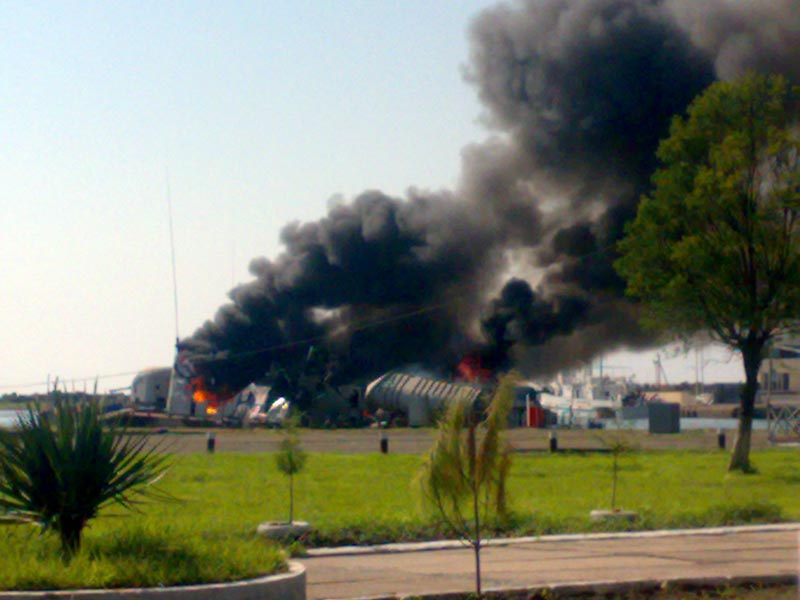
We took up station guarding the opposed landing on the Abkhaz shore when all of a sudden four high speed targets were detected. We sent out an IFF signal and the targets didn't react. Receiving a command from the flagship, we got into formation and right at that moment the unidentified targets opened fire on the ship formation and flagship. The cruiser was damaged and a small fire broke out aboard. Then, fearing for seaworthyness, the flagship withdrew from the firing area." - the sailor said.
"Right then the small missile boats clearly fired," the participant continued. "Taking up position, our MRK launched a "Malakhit" (SS-N-9) anti-surface missile, which literally cut the lead ship, the "Tbilisi" to ribbons. After that, fire was shifted to the rest of the Georgian ships. Another ship was damaged, we couldn't finish it off, allowing it to leave the scene under its own power.



Sundown at Coffin Rock
by Raymond K. Paden
The old man walked slowly through the dry, fallen leaves of autumn, his practiced eye automatically choosing the bare and stony places in the trail for his feet. There was scarcely a sound as he passed, though his left knee was stiff with scar tissue. He grunted occasionally as the tight sinews pulled. Damn chainsaw, he thought.
Behind him, the boy shuffled along, trying to imitate his grandfather, but unable to mimic the silent motion that the old man had learned during countless winter days upon this wooded mountain in pursuit of game. He's fifteen years old, the old man thought. Plenty old enough to be learning. But that was another time, another America. His mind drifted, and he saw himself, a fifteen-year-old boy following in the footsteps of his own grandfather, clutching a twelve gauge in his trembling hands as they tracked a wounded whitetail.
The leg was hurting worse now, and he slowed his pace a bit. Plenty of time. It should have been my own son here with me now, the old man thought sadly. But Jason had no interest, no understanding. He cared for nothing but pounding on the keys of that damned computer terminal. He knew nothing about the woods, or where food came from...or freedom. And that's my fault, isn't it?
The old man stopped and held up his hand, motioning for the boy to look. In the small clearing ahead, the deer stood motionless, watching them. It was a scraggly buck, underfed and sickly, but the boy's eyes lit up with excitement. It had been many years since they had seen even a single whitetail here on the mountain. After the hunting had stopped, the population had exploded. The deer had eaten the mountain almost bare until erosion had become a serious problem in some places. That following winter, three starving does had wandered into the old man's yard, trying to eat the bark off of his pecan trees, and he had wished the "animal rights" fanatics could have been there then. It was against the law, but old man knew a higher law, and he took an axe into the yard and killed the starving beasts. They did not have the strength to run.
The buck finally turned and loped away, and they continued down the trail to the river. When they came to the "Big Oak," the old man turned and pushed through the heavy brush beside the trail and the boy followed, wordlessly. The old man knew that Thomas was curious about their leaving the trail, but the boy had learned to move silently (well, almost) and that meant no talking. When they came to "Coffin Rock," the old man sat down upon it and motioned for the boy to join him.
"You see this rock, shaped like a casket?" the old man asked. "Yes sir." The old man smiled. The boy was respectful and polite. He loved the outdoors, too. Everything a man could ask in a grandson ....or a son.
"I want you to remember this place, and what I'm about to tell you. A lot of it isn't going to make any sense to you, but it's important and one day you'll understand it well enough. The old man paused. Now that he was here, he didn't really know where to start.
"Before you were born," he began at last, "this country was different. I've told you about hunting, about how everybody who obeyed the law could own guns. A man could speak out, anywhere, without worrying about whether he'd get back home or not. School was different, too. A man could send his kids to a church school, or a private school, or even teach them at home. But even in the public schools, they didn't spend all their time trying to brainwash you like they do at yours now." The old man paused, and was silent for many minutes. The boy was still, watching a chipmunk scavenging beside a fallen tree below them.
"Things don't ever happen all at once, boy. They just sort of sneak up on you. Sure, we knew guns were important; we just didn't think it would ever happen in America. But we had to do something about crime, they said. It was a crisis. Everything was a crisis! It was a drug crisis, or a terrorism crisis, or street crime, or gang crime. Even a 'health care' crisis was an excuse to take away a little more of our rights." The old man turned to look at his grandson.
"They ever let you read a thing called the Constitution down there at your school?" The boy solemnly shook his head. "Well, the Fourth Amendment's still in there. It says there won't be any unreasonable searches and seizures. It says you're safe in your own home." The old man shrugged. "That had to go. It was a crisis! They could kick your door open any time, day or night, and come in with guns blazing if they thought you had drugs ...or later, guns. Oh, at first it was just registration -- to keep the guns out of the hands of criminals! But that didn't work, of course, and then later when they wanted to take 'em they knew where to look. They banned 'assault rifles', and then 'sniper rifles', and 'Saturday night specials.' Everything you saw on the TV or in the movies was against us. God knows the news people were! And the schools were teaching our kids that nobody needed guns anymore. We tried to take a stand, but we felt like the whole face of our country had changed and we were left outside."
"Me and a friend of mine, when we saw what was happening, we came and built a secret place up here on the mountain. A place where we could put our guns until we needed them. We figured some day Americans would remember what it was like to be free, and what kind of price we had to pay for that freedom. So we hid our guns instead of losing them."
"One fellow I knew disagreed. He said we ought to use our guns now and stand up to the government. Said that the colonists had fought for their freedom when the British tried to disarm them at Lexington and Concord. Well, he and a lot of others died in what your history books call the 'Tax Revolt of 1998,' but son, it wasn't the revolt that caused the repeal of the Second Amendment like your history book says. The Second Amendment was already gone long before they ever repealed it. The rest of us thought we were doing the right thing by waiting. I hope to God we were right."
"You see, Thomas. It isn't government that makes a man free. In the end, governments always do just the opposite. They gobble up freedom like hungry pigs. You have to have laws to keep the worst in men under control, but at the same time the people have to have guns, too, in order to keep the government itself under control. In our country, the people were supposed to be the final authority of the law, but that was a long time ago. Once the guns were gone, there was no reason for those who run the government to give a damn about laws and constitutional rights and such. They just did what they pleased and anyone who spoke out...well, I'm getting ahead of myself."
"It took a long time to collect up all the millions of firearms that were in private hands. The government created a whole new agency to see to it. There were rewards for turning your friends in, too. Drug dealers and murderers were set free after two or three years in prison, but possession of a gun would get you mandatory life behind bars with no parole.
"I don't know how they found out about me, probably knew I'd been a hunter all those years, or maybe somebody turned me in. They picked me up on suspicion and took me down to the federal building."
"Son, those guys did everything they could think of to me. Kept me locked up in this little room for hours, no food, no water. They kept coming in, asking me where the guns were. 'What guns?' I said. Whenever I'd doze off, they'd come crashing in, yelling and hollering. I got to where I didn't know which end was up. I'd say I wanted my lawyer and they'd laugh. 'Lawyers are for criminals', they said. 'You'll get a lawyer after we get the guns.' What's so funny is, I know they thought they were doing the right thing. They were fighting crime!"
"When I got home I found Ruth sitting in the middle of the living room floor, crying her eyes out. The house was a shambles. While I was down there, they'd come out and took our house apart. Didn't need a search warrant, they said. National emergency! Gun crisis! Your grandma tried to call our preacher and they ripped the phone off the wall. Told her that they'd go easy on me if she just told them where I kept my guns." The old man laughed. "She told them to go to hell." He stared into the distance for a moment as his laughter faded.
"They wouldn't tell her about me, where I was or anything, that whole time. She said that she'd thought I was dead. She never got over that day, and she died the next December."
"They've been watching me ever since, off and on. I guess there's not much for them to do anymore, now that all the guns are gone. Plenty of time to watch one foolish old man." He paused. Beside him, the boy stared at the stone beneath his feet.
"Anyway, I figure that, one day, America will come to her senses. Our men will need those guns and they'll be ready. We cleaned them and sealed them up good; they'll last for years. Maybe it won't be in your lifetime, Thomas. Maybe one day you'll be sitting here with your son or grandson. Tell him about me, boy. Tell him about the way I said America used to be." The old man stood, his bad leg shaking unsteadily beneath him.
"You see the way this stone points? You follow that line one hundred feet down the hill and you'll find a big round rock. It looks like it's buried solid, but one man with a good prybar can lift it, and there's a concrete tunnel right under there that goes back into the hill."
The old man stood, watching as the sun eased toward the ridge, coloring the sky and the world red. Below them, the river still splashed among the stones, as it had for a million years. It's still going, the old man thought. There'll be someone left to carry on for me when I'm gone. It was harder to walk back. He felt old and purposeless now, and it would be easier, he knew, to give in to that aching heaviness in his left lung that had begun to trouble him more and more. Damn cigarettes, he thought. His leg hurt, and the boy silently came up beside him and supported him as they started down the last mile toward the house. How quiet he walks, the old man thought. He's learned well.
It was almost dark when the boy walked in. His father looked up from his paper. "Did you and your granddad have a nice walk?"
"Yes," the boy answered, opening the refrigerator. "You can call Agent Goodwin tomorrow. Gramps finally showed me where it is."
Nor is it at all clear to me how the majority decides which loaded "arms" a homeowner may keep. The majority says that that Amendment protects those weapons "typically possessed by law-abiding citizens for lawful purposes." Ante, at 53. This definition conveniently excludes machineguns, but permits handguns, which the majority describes at "the most popular weapon chosen by Americans for self-defense in the home." Ante, at 57, see also ante, at 54-55. But what sense does this approach make? According to the majority's reasoning, if Congress and the States lift restrictions on the possession and use of machineguns, and people buy machineguns to protect their homes, the court will have to reverse course and find that the Second Amendment does, in fact, protect the individual self-defense-related right to possess a machinegun. On the majority's reasoning, if tomorrow someone invents a particularly useful, highly dangerous self-defense weapon, Congress and the States had better ban it immediately, for once it becomes popular Congress will no longer possess the constitutional authority to do so. In essence, the majority determines what regulations are permissible by looking to see what existing regulations permit. There is no basis for believing that the Framers intended such circular reasoning.
We think that Miller's "ordinary military equipment" language must be read in tandem with what comes after: "[O]rdinarily when called for [militia]service [able-bodied] men were expected to appear bearing arms supplied by themselves and of the kind in common use at the time." The traditional militia was formed from a pool of men bringing arms "in common use at the time" for lawful purposes like self-defense. "In the colonial and revolutionary era, [small-arms] weapons used by militiamen and weapons used in defense of person and home were one and the same."
We also recognize another important limitation on the right to keep and carry arms. Miller said, as we have explained, that the sorts of weapons protected were those "in common use at the time." We think that limitation is fairly supported by the historical tradition of prohibiting the carrying of "dangerous and unusual weapons."
It may be objected that if weapons that are most useful in military service--M-16 rifles and the like--may be banned, then the Second Amendment right is completely detached from the prefatory clause. But as we have said, the conception of the militia at the time of the Second Amendment's ratification was the body of all citizens capable of military service, would would bring the sorts of lawful weapons that possessed at home to militia duty. Indeed, it may be true that no amount of small arms could be useful against modern-day bombers and tanks. But the fact that modern developments have limited the degree of fit between the prefatory clause and the protected right cannot change our interpretation of the right.
The following shall be nationals and citizens of the United States at birth: ... (e) a person born in an outlying possession of the United States of parents one of whom is a citizen of the United States who has been physically present in the United States or one of its outlying possessions for a continuous period of one year at any time prior to the birth of such person8 USC 1401.