Also: Look out Chuck Norris, you have incoming!
Russian ultranationalist Vladimir Zhirinovsky once threatened to reannex Alaska. Now, however, Dimitry Medvedev stays up nights worried that Sarah Palin will annex Russia.
Russian ultranationalist Vladimir Zhirinovsky once threatened to reannex Alaska. Now, however, Dimitry Medvedev stays up nights worried that Sarah Palin will annex Russia.
This is true: fact is king. Information is king. Great reporting is what every honest person wants now, it's the one ironic thing we have less of in journalism than we need. But reporting that carries an agenda, that carries Bubblehead assumptions and puts them forth as obvious truths? Well, some people want that. But if I were doing a business model for broadsheets and broadcast networks I'd say: Fact and data are our product, we're putting everything into reporting, that's what we're selling, interpretation is the reader's job, and think pieces are for the edit page where we put the hardy, blabby hacks.
That was a long way of saying: Dig deep into Sarah Palin, get all you can, talk to everybody, get every vote, every quote, tell us of her career and life, she may be the next vice president. But don't play games. And leave her kid alone, bitch.
With the Navy being given the green light, we are about to observe the first major US Navy operation since the 2005 Tsunami. That may not sound like much to those not familiar with that story, but it is. These events will further shape the way we look at military power strategically.
For the second time in the 21st century, the United States is about to exercise military power in a major way other than war, but instead of confronting the challenge of a natural disaster, this time the confrontation is with a military power exercising political control. Is this a military mission? In the 21st century, yes.
But not in your traditional way. This is the perfect example why military strategy is incomplete when it focuses only on the duties of conducting war. This is not a peacekeeping mission, peacekeeping is what nations do when the UN asks them to fill space between wars. This scenario, the full spectrum multi-agency option other than war, logistically supported by the tools of war, is what we mean when we use the world peacemaking in 21st century strategy.
This is the black dot in the white side of the Yin Yang. This will be interesting.
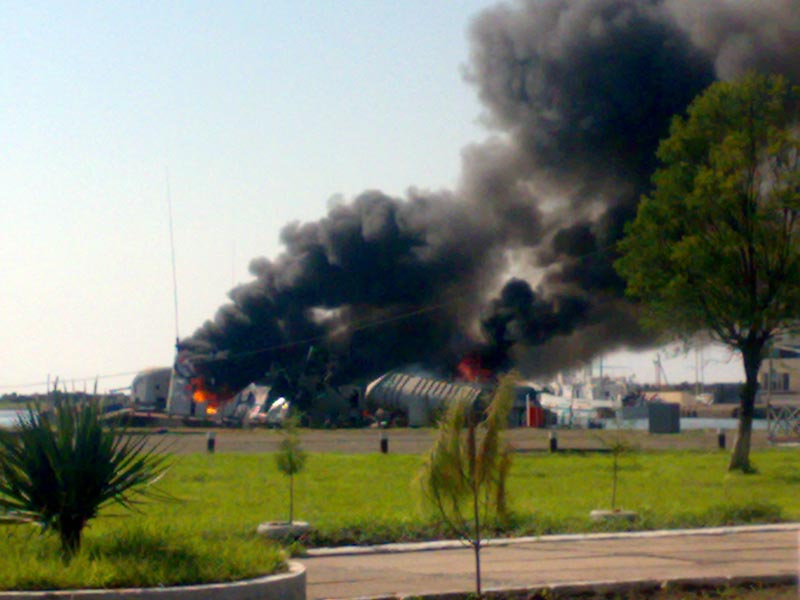
We took up station guarding the opposed landing on the Abkhaz shore when all of a sudden four high speed targets were detected. We sent out an IFF signal and the targets didn't react. Receiving a command from the flagship, we got into formation and right at that moment the unidentified targets opened fire on the ship formation and flagship. The cruiser was damaged and a small fire broke out aboard. Then, fearing for seaworthyness, the flagship withdrew from the firing area." - the sailor said.
"Right then the small missile boats clearly fired," the participant continued. "Taking up position, our MRK launched a "Malakhit" (SS-N-9) anti-surface missile, which literally cut the lead ship, the "Tbilisi" to ribbons. After that, fire was shifted to the rest of the Georgian ships. Another ship was damaged, we couldn't finish it off, allowing it to leave the scene under its own power.



Sundown at Coffin Rock
by Raymond K. Paden
The old man walked slowly through the dry, fallen leaves of autumn, his practiced eye automatically choosing the bare and stony places in the trail for his feet. There was scarcely a sound as he passed, though his left knee was stiff with scar tissue. He grunted occasionally as the tight sinews pulled. Damn chainsaw, he thought.
Behind him, the boy shuffled along, trying to imitate his grandfather, but unable to mimic the silent motion that the old man had learned during countless winter days upon this wooded mountain in pursuit of game. He's fifteen years old, the old man thought. Plenty old enough to be learning. But that was another time, another America. His mind drifted, and he saw himself, a fifteen-year-old boy following in the footsteps of his own grandfather, clutching a twelve gauge in his trembling hands as they tracked a wounded whitetail.
The leg was hurting worse now, and he slowed his pace a bit. Plenty of time. It should have been my own son here with me now, the old man thought sadly. But Jason had no interest, no understanding. He cared for nothing but pounding on the keys of that damned computer terminal. He knew nothing about the woods, or where food came from...or freedom. And that's my fault, isn't it?
The old man stopped and held up his hand, motioning for the boy to look. In the small clearing ahead, the deer stood motionless, watching them. It was a scraggly buck, underfed and sickly, but the boy's eyes lit up with excitement. It had been many years since they had seen even a single whitetail here on the mountain. After the hunting had stopped, the population had exploded. The deer had eaten the mountain almost bare until erosion had become a serious problem in some places. That following winter, three starving does had wandered into the old man's yard, trying to eat the bark off of his pecan trees, and he had wished the "animal rights" fanatics could have been there then. It was against the law, but old man knew a higher law, and he took an axe into the yard and killed the starving beasts. They did not have the strength to run.
The buck finally turned and loped away, and they continued down the trail to the river. When they came to the "Big Oak," the old man turned and pushed through the heavy brush beside the trail and the boy followed, wordlessly. The old man knew that Thomas was curious about their leaving the trail, but the boy had learned to move silently (well, almost) and that meant no talking. When they came to "Coffin Rock," the old man sat down upon it and motioned for the boy to join him.
"You see this rock, shaped like a casket?" the old man asked. "Yes sir." The old man smiled. The boy was respectful and polite. He loved the outdoors, too. Everything a man could ask in a grandson ....or a son.
"I want you to remember this place, and what I'm about to tell you. A lot of it isn't going to make any sense to you, but it's important and one day you'll understand it well enough. The old man paused. Now that he was here, he didn't really know where to start.
"Before you were born," he began at last, "this country was different. I've told you about hunting, about how everybody who obeyed the law could own guns. A man could speak out, anywhere, without worrying about whether he'd get back home or not. School was different, too. A man could send his kids to a church school, or a private school, or even teach them at home. But even in the public schools, they didn't spend all their time trying to brainwash you like they do at yours now." The old man paused, and was silent for many minutes. The boy was still, watching a chipmunk scavenging beside a fallen tree below them.
"Things don't ever happen all at once, boy. They just sort of sneak up on you. Sure, we knew guns were important; we just didn't think it would ever happen in America. But we had to do something about crime, they said. It was a crisis. Everything was a crisis! It was a drug crisis, or a terrorism crisis, or street crime, or gang crime. Even a 'health care' crisis was an excuse to take away a little more of our rights." The old man turned to look at his grandson.
"They ever let you read a thing called the Constitution down there at your school?" The boy solemnly shook his head. "Well, the Fourth Amendment's still in there. It says there won't be any unreasonable searches and seizures. It says you're safe in your own home." The old man shrugged. "That had to go. It was a crisis! They could kick your door open any time, day or night, and come in with guns blazing if they thought you had drugs ...or later, guns. Oh, at first it was just registration -- to keep the guns out of the hands of criminals! But that didn't work, of course, and then later when they wanted to take 'em they knew where to look. They banned 'assault rifles', and then 'sniper rifles', and 'Saturday night specials.' Everything you saw on the TV or in the movies was against us. God knows the news people were! And the schools were teaching our kids that nobody needed guns anymore. We tried to take a stand, but we felt like the whole face of our country had changed and we were left outside."
"Me and a friend of mine, when we saw what was happening, we came and built a secret place up here on the mountain. A place where we could put our guns until we needed them. We figured some day Americans would remember what it was like to be free, and what kind of price we had to pay for that freedom. So we hid our guns instead of losing them."
"One fellow I knew disagreed. He said we ought to use our guns now and stand up to the government. Said that the colonists had fought for their freedom when the British tried to disarm them at Lexington and Concord. Well, he and a lot of others died in what your history books call the 'Tax Revolt of 1998,' but son, it wasn't the revolt that caused the repeal of the Second Amendment like your history book says. The Second Amendment was already gone long before they ever repealed it. The rest of us thought we were doing the right thing by waiting. I hope to God we were right."
"You see, Thomas. It isn't government that makes a man free. In the end, governments always do just the opposite. They gobble up freedom like hungry pigs. You have to have laws to keep the worst in men under control, but at the same time the people have to have guns, too, in order to keep the government itself under control. In our country, the people were supposed to be the final authority of the law, but that was a long time ago. Once the guns were gone, there was no reason for those who run the government to give a damn about laws and constitutional rights and such. They just did what they pleased and anyone who spoke out...well, I'm getting ahead of myself."
"It took a long time to collect up all the millions of firearms that were in private hands. The government created a whole new agency to see to it. There were rewards for turning your friends in, too. Drug dealers and murderers were set free after two or three years in prison, but possession of a gun would get you mandatory life behind bars with no parole.
"I don't know how they found out about me, probably knew I'd been a hunter all those years, or maybe somebody turned me in. They picked me up on suspicion and took me down to the federal building."
"Son, those guys did everything they could think of to me. Kept me locked up in this little room for hours, no food, no water. They kept coming in, asking me where the guns were. 'What guns?' I said. Whenever I'd doze off, they'd come crashing in, yelling and hollering. I got to where I didn't know which end was up. I'd say I wanted my lawyer and they'd laugh. 'Lawyers are for criminals', they said. 'You'll get a lawyer after we get the guns.' What's so funny is, I know they thought they were doing the right thing. They were fighting crime!"
"When I got home I found Ruth sitting in the middle of the living room floor, crying her eyes out. The house was a shambles. While I was down there, they'd come out and took our house apart. Didn't need a search warrant, they said. National emergency! Gun crisis! Your grandma tried to call our preacher and they ripped the phone off the wall. Told her that they'd go easy on me if she just told them where I kept my guns." The old man laughed. "She told them to go to hell." He stared into the distance for a moment as his laughter faded.
"They wouldn't tell her about me, where I was or anything, that whole time. She said that she'd thought I was dead. She never got over that day, and she died the next December."
"They've been watching me ever since, off and on. I guess there's not much for them to do anymore, now that all the guns are gone. Plenty of time to watch one foolish old man." He paused. Beside him, the boy stared at the stone beneath his feet.
"Anyway, I figure that, one day, America will come to her senses. Our men will need those guns and they'll be ready. We cleaned them and sealed them up good; they'll last for years. Maybe it won't be in your lifetime, Thomas. Maybe one day you'll be sitting here with your son or grandson. Tell him about me, boy. Tell him about the way I said America used to be." The old man stood, his bad leg shaking unsteadily beneath him.
"You see the way this stone points? You follow that line one hundred feet down the hill and you'll find a big round rock. It looks like it's buried solid, but one man with a good prybar can lift it, and there's a concrete tunnel right under there that goes back into the hill."
The old man stood, watching as the sun eased toward the ridge, coloring the sky and the world red. Below them, the river still splashed among the stones, as it had for a million years. It's still going, the old man thought. There'll be someone left to carry on for me when I'm gone. It was harder to walk back. He felt old and purposeless now, and it would be easier, he knew, to give in to that aching heaviness in his left lung that had begun to trouble him more and more. Damn cigarettes, he thought. His leg hurt, and the boy silently came up beside him and supported him as they started down the last mile toward the house. How quiet he walks, the old man thought. He's learned well.
It was almost dark when the boy walked in. His father looked up from his paper. "Did you and your granddad have a nice walk?"
"Yes," the boy answered, opening the refrigerator. "You can call Agent Goodwin tomorrow. Gramps finally showed me where it is."
Nor is it at all clear to me how the majority decides which loaded "arms" a homeowner may keep. The majority says that that Amendment protects those weapons "typically possessed by law-abiding citizens for lawful purposes." Ante, at 53. This definition conveniently excludes machineguns, but permits handguns, which the majority describes at "the most popular weapon chosen by Americans for self-defense in the home." Ante, at 57, see also ante, at 54-55. But what sense does this approach make? According to the majority's reasoning, if Congress and the States lift restrictions on the possession and use of machineguns, and people buy machineguns to protect their homes, the court will have to reverse course and find that the Second Amendment does, in fact, protect the individual self-defense-related right to possess a machinegun. On the majority's reasoning, if tomorrow someone invents a particularly useful, highly dangerous self-defense weapon, Congress and the States had better ban it immediately, for once it becomes popular Congress will no longer possess the constitutional authority to do so. In essence, the majority determines what regulations are permissible by looking to see what existing regulations permit. There is no basis for believing that the Framers intended such circular reasoning.
We think that Miller's "ordinary military equipment" language must be read in tandem with what comes after: "[O]rdinarily when called for [militia]service [able-bodied] men were expected to appear bearing arms supplied by themselves and of the kind in common use at the time." The traditional militia was formed from a pool of men bringing arms "in common use at the time" for lawful purposes like self-defense. "In the colonial and revolutionary era, [small-arms] weapons used by militiamen and weapons used in defense of person and home were one and the same."
We also recognize another important limitation on the right to keep and carry arms. Miller said, as we have explained, that the sorts of weapons protected were those "in common use at the time." We think that limitation is fairly supported by the historical tradition of prohibiting the carrying of "dangerous and unusual weapons."
It may be objected that if weapons that are most useful in military service--M-16 rifles and the like--may be banned, then the Second Amendment right is completely detached from the prefatory clause. But as we have said, the conception of the militia at the time of the Second Amendment's ratification was the body of all citizens capable of military service, would would bring the sorts of lawful weapons that possessed at home to militia duty. Indeed, it may be true that no amount of small arms could be useful against modern-day bombers and tanks. But the fact that modern developments have limited the degree of fit between the prefatory clause and the protected right cannot change our interpretation of the right.
The following shall be nationals and citizens of the United States at birth: ... (e) a person born in an outlying possession of the United States of parents one of whom is a citizen of the United States who has been physically present in the United States or one of its outlying possessions for a continuous period of one year at any time prior to the birth of such person8 USC 1401.
WASHINGTON (AP) -- An Air Force investigation of the crash last fall of an F-15C Eagle concluded that a defective metal beam in the frame cracked, causing it to disintegrate during flight.
In a report being released Thursday, obtained in advance by The Associated Press, Air Force investigators said they had found the sole reason for the accident was the faulty support beam, called a longeron, which failed to meet the manufacturer's specifications.
The investigation was led by Air Force Col. William Wignall. Video Watch animation and audio from F-15 crash »
"The accident investigation board president (Wignall) found, by clear and convincing evidence, the cause of this accident was a failure of the upper right longeron, a critical support structure in the F-15C aircraft," the report says.
About 20 minutes after takeoff from an airfield near St. Louis on November 2, the forward fuselage of Maj. Stephen Stilwell's $42 million F-15C Eagle shook violently and then broke apart 18,000 feet above the ground. Stilwell, his left shoulder dislocated and his left arm shattered, barely had time to safely eject as pieces of his aircraft tumbled from the sky over the Missouri countryside.
More troubling, however, are the results of a parallel examination finding as many as 163 of the workhorse aircraft also have flawed support beams, or longerons. The aircraft remain grounded as the Air Force continues to search for how serious the problem is and whether extensive, costly repairs are needed. Another 19 of the aircraft have yet to be inspected and also remain grounded.
Nearly 260 of the A through D model F-15s, first fielded in the mid-1970s, were returned to flight status Tuesday following fleet-wide inspections.
The twin-engine aircraft are used primarily for homeland security and are a key link in the nation's air defense network.
"Two November, my world really changed," Air Force Gen. John Corley, head of Air Combat Command at Langley Air Force Base, Virginia, said at a Pentagon news conference. "And it changed in a catastrophic way."
The Air Force's fleet of 224 newer F-15E Strike Eagles, which are used in Iraq and Afghanistan, do not have the structural problem. Those jets, whose role is more oriented toward ground attack missions, were temporarily grounded after Stilwell's crash, but returned to service shortly thereafter.
The older F-15s are stationed at many so-called "alert" sites around the country, where planes and pilots stand ready to take off at a moment's notice to intercept hijacked airliners and guard protected airspace.
Among the Air Force's other workhorse fighter jets is the F-16, which performs multiple roles, including air-to-air combat and air-to-ground attack. It entered the operational fleet in 1979.
With the F-15s temporarily grounded, F-16s and other aircraft are pulled away from their regular duties to fill the gaps. That makes it difficult for the Air Force to accomplish its mission and leaves Air Force pilots unable to train properly.
"This is systemic," Corley said.
The longeron helps support the cockpit and strengthen the jet as it moves through high-stress maneuvers while traveling hundreds of miles per hour.
Analysis of recovered parts from Stilwell's jet identified a crack in the beam near the fuselage that investigators say grew over time and was not detected during regular maintenance of the aircraft.
In the report, Wignall said that prior to Stilwell's flight, "no inspection requirements existed for detecting a crack in the longeron."
The F-15A through D models were built by McDonnell Douglas. That company merged with defense manufacturing giant Boeing in August 1997.
Company spokeswoman Patricia Frost said Boeing representatives have not seen Wignall's final report and could not comment on it.
"However, we are working with the U.S. Air Force to analyze the data gathered from fleet-wide inspections," Frost said. "Once all of the data have been analyzed, a need for further inspection or repair can be determined."
No decision has been reached as to whether Boeing might be liable for the repairs, which could cost as much as $500,000 per aircraft.
"This is the starting point for looking into that question," said Lt. Gen. Donald Hoffman, a senior Air Force acquisition official. "I'm not going to speculate."
The F-22 Raptor, a stealth aircraft intended to replace the F-15, is being fielded but in smaller numbers than initially planned. The Pentagon has said it will buy just 183 Raptors due to their high cost, but members of Congress are pressing Defense Secretary Robert Gates to buy more. A single Raptor costs about $160 million, according to the Air Force.
The Air Force has said it needs 381 of the F-22s.
Corley did not endorse more F-22s as the solution to the F-15 problems. But he indicated buying more F-15s would not be the Air Force's preference.
"It was the best of breed at its time," said Corley, who was an F-15 instructor pilot in 1979. "It's not anymore."
advertisement
Loren Thompson, a defense analyst with the Lexington Institute in Arlington, Virginia, said it may make more sense to retire the older F-15s rather than fix them. Due to their age, another part could fail even after the longerons are repaired.
"This is an aircraft that was designed during the Nixon administration," Thompson said. "It doesn't seem sensible to be making fixes so late in the game."
Net Assessment: United States
Stratfor Today » December 31, 2007 | 2343 GMT
Brendan Smialowski
There are those who say that perception is reality. Geopolitics teaches the exact opposite: There is a fundamental reality to national power, and the passing passions of the public have only a transitory effect on things. In order to see the permanent things, it is important to tune out the noise and focus on the reality. That is always hard, but nowhere more so than in the United States, where the noise is incredibly loud, quite insistent, and profoundly contradictory and changeable. Long dissertations can and should be written on the dynamics of public opinion in the United States. For Stratfor, the root of these contradictions is in the dynamism of the United States. You can look at the United States and be awed by its dynamic power, and terrified by it at the same time.
All nations have complex psyches, but the American is particularly complex, contradictory and divisive. It is torn between two poles: dread and hubris. They alternate and compete and tear at each other. Neither dominates. They are both just there, tied to each other. The dread comes from a feeling of impending doom, the hubris from constantly overcoming it.
Hubris is built into American history. The American republic was founded to be an exemplary regime, one that should be emulated. This sense of exceptionality was buttressed by the doctrine of manifest destiny, the idea that the United States in due course would dominate the continent. Americans pushed inward to discover verdant horizons filled with riches one after another, indelibly impressing upon them that life was supposed to get better and that setbacks were somehow unnatural. It is hard not to be an economic superpower when you effectively have an entire continent to yourself, and it is especially hard not to be a global economic hegemon once you’ve tamed that continent and use it as a base from which to push out. But the greatest driver for American hubris was the extraordinary economic success of the United States, and in particular its extraordinary technological achievements. There is a sense that there is nothing that the United States cannot achieve — and no limits to American power.
But underlying this extraordinary self-confidence is a sense of dread. To understand the dread, we have to understand the 1930s. The 1920s were a time of apparent peace and prosperity: World War I was over, and the United States was secure and prosperous. The market crash of 1929, followed by the Great Depression, imprinted itself on the American psyche. There is a perpetual fear that underneath the apparent prosperity of our time, economic catastrophe lurks. It is a sense that well-being masks a deep economic sickness. Part of the American psyche is braced for disaster.
This dread also has roots in Pearl Harbor, and the belief that it and the war that followed for the United States was the result of complacency and inattentiveness. Some argued that the war was caused by America’s failure to join the League of Nations. Others claimed that the fault lay in the failure to act decisively to stop Hitler and Tojo before they accumulated too much power. In either case, the American psyche is filled with a dread of the world, that the smallest threat might blossom into world war, and that failure to act early and decisively will bring another catastrophe. At the same time, from Washington’s farewell address to failures in Vietnam or Iraq, there has been the fear that American entanglement with the world is not merely dangerous, but it is the path to catastrophe.
This fault line consistently polarizes American politics, dividing it between those who overestimate American power and those who underestimate it. In domestic politics, every boom brings claims that the United States has created a New Economy that has abolished the business cycle. Every shift in the business cycle brings out the faction that believes the collapse of the American economy is just over the horizon. Sometimes, the same people say both things within months of each other.
The purpose of a net assessment is not to measure such perceptions, but to try to benchmark military, economic and political reality, treating the United States as if it were a foreign country. We begin by “being stupid”: that is, by stating the obvious and building from it, rather than beginning with complex theories. In looking at the United States, two obvious facts come to light.
First, the United States controls all of the oceans in the world. No nation in human history has controlled the oceans so absolutely. That means the United States has the potential to control, if it wishes, the flow of goods through the world’s oceans — which is the majority of international trade. Since World War II, the United States has used this power selectively. In general, it has used its extraordinary naval superiority to guarantee free navigation, because international trade has been one of the foundations of American prosperity. But it has occasionally used its power as a tool to shape foreign affairs or to punish antagonistic powers. Control of the oceans also means that the United States can invade other countries, and that — unless Canada or Mexico became much more powerful than they are now — other countries cannot invade the United States.
Second, no economy in the world is as large as the American economy. In 2006, the gross domestic product (GDP) of the United States was about $13.2 trillion. That is 27.5 percent of all goods and services produced in the world for that year, and it is larger than the combined GDPs of the next four countries — Japan, Germany, China and the United Kingdom. In spite of de-industrialization, industrial production in the United States was $2.1 trillion, equal to Japan’s, China’s and Germany’s industrial production combined. You can argue with the numbers, and weight them any number of ways, but the fact is that the United States is economically huge, staggeringly so. Everything from trade deficits to subprime mortgage crises must be weighed against the sheer size of the American economy and the fact that it is and has been expanding.
If you begin by being stupid instead of sophisticated, you are immediately struck by the enormity of American military power, based particularly on its naval power and its economic power, which in turn is based on the size and relative balance of the economy. The United States is the 2,000-pound gorilla of the international system. That means blows that would demolish other nations are absorbed with relative ease by the United States, while at the same time drawing howls of anguish that would lead you to assume the United States is on the eve of destruction. That much military and economic power does not collapse very easily or quickly.
The United States has two simple strategic goals. The first is to protect itself physically from attack to ensure its economy continues to flourish. Attacks against the United States are unpleasant, but invasion by a foreign power is catastrophic. Therefore the second goal is to maintain control of the seas. So long as the oceans are controlled by the U.S. Navy — and barring nuclear attack — the physical protection of the United States is assured. Therefore the United States has two interests. The first is preventing other nations from challenging American naval hegemony. The second is preventing other nations from acquiring nuclear weapons, and intimidating those who already have them.
The best way to prevent a challenge by another fleet is to make certain the fleet is never built. The best way to do that is to prevent the rise of regional hegemons, particularly in Eurasia, that are secure enough to build navies. The American strategy in Eurasia is the same as Britain’s in Europe — maintain the balance of power so that no power or coalition of powers can rise up as a challenger. The United States, rhetoric aside, has no interest in Eurasia except for maintaining the balance of power — or failing that, creating chaos.
The United States intervenes periodically in Eurasia, and elsewhere. Its goals appear to be incoherent and its explanations make little sense, but its purpose is single-minded. The United States does not want to see any major, stable power emerge in Eurasia that could, in the long term, threaten American interests either by building a naval challenge or a nuclear one. As powers emerge, the United States follows a three-stage program. First, provide aid to weaker powers to contain and undermine emerging hegemons. Second, create more formal arrangements with these powers. Finally, if necessary, send relatively small numbers of U.S. troops to Eurasia to block major powers and destabilize regions.
The basic global situation can be described simply. The United States has overwhelming power. It is using that power to try to prevent the emergence of any competing powers. It is therefore constantly engaged in interventions on a political, economic and military level. The rest of the world is seeking to limit and control the United States. No nation can do it alone, and therefore there is a constant attempt to create coalitions to contain the United States. So far, these coalitions have tended to fail, because potential members can be leveraged out of the coalition by American threats or incentives. Nevertheless, between constant American intrusions and constant attempts to contain American power, the world appears to be disorderly and dangerous. It might well be dangerous, but it has far more logic and order than it might appear.
U.S. Foreign Policy
The latest American foreign policy actions began after 9/11. Al Qaeda posed two challenges to the United States. The first was the threat of follow-on attacks, potentially including limited nuclear attacks. The second and more strategic threat was al Qaeda’s overall goal, which was to recreate an Islamic caliphate. Put in an American context, al Qaeda wanted to create a transnational “Islamic” state that, by definition, would in the long run be able to threaten U.S. power. The American response was complex. Its immediate goal was the destruction of al Qaeda. Its longer-term goal was the disruption of the Islamic world. The two missions overlapped but were not identical. The first involved a direct assault against al Qaeda’s command-and-control facilities: the invasion of Afghanistan. The second was an intrusion into the Islamic world designed to disrupt it without interfering with the flow of oil from the region.
U.S. grand strategy has historically operated by splitting enemy coalitions and partnering with the weaker partner. Thus, in World War II, the United States sided with the Soviet Union against Nazi Germany after their alliance collapsed. During the Cold War, the United States sided with Communist China against the Soviet Union after the Sino-Soviet split. Following that basic strategy, the United States first sided with and then manipulated the Sunni-Shiite split. In all these cases the goal was to disrupt and prevent the formation of a coalition that could threaten the United States.
Looked at from 50,000 feet, that was the result of the invasion of Iraq. It set the Sunnis and Shia against each other. Whether this idea was subjectively in the minds of American planners at the time is not really relevant. That it played out the U.S. model in foreign policy is what matters. The invasion of Iraq resulted in chaos. About 3,000 American troops were killed, a small number compared to previous multiyear, multidivisional wars. Not only did the Islamic world fail to coalesce into a single entity, but its basic fault line, Sunnis versus Shia, erupted into a civil war in Iraq. That civil war disrupted the threats of coalition formation and of the emergence of regional hegemons. It did create chaos. That chaos provided a solution to American strategic problems, while U.S. intelligence dealt with the lesser issue of breaking up al Qaeda.
The U.S. interest in the Islamic world at the moment is to reduce military operations and use the existing internal tension among Muslims to achieve American military ends. The reason for reducing military operations is geopolitical, and it hinges on Russia.
The total number of U.S. casualties in Iraq is relatively small, but the level of effort, relative to available resources, has essentially consumed most of America’s ground capabilities. The United States has not substantially increased the size of its army since the invasion of Iraq. There were three reasons for this. First, the United States did not anticipate the level of resistance. Second, rhetoric aside, U.S. strategy was focused on disruption, not nation-building, and a larger force was not needed for that. Third, the global geopolitical situation did not appear to require U.S. forces elsewhere. Therefore, Washington chose not to pay the price for a larger force.
The geopolitical situation has changed. The U.S. absorption in the Islamic world has opened the door for a more assertive Russia, which is engaged in creating a regional sphere of influence in the former Soviet Union. Following the American grand strategy of preventing the emergence of Eurasian regional powers, the United States must now put itself in a position to disrupt and/or contain Russia. With U.S. forces tied down in the Islamic world, there are no reserves for this mission. The United States is therefore engaged in a process of attempting to reduce its presence in the Islamic world, while repositioning to deal with the Russians.
The process of disengagement is enormously complex. Having allied with the Shia (including Iran) to disrupt al Qaeda, the United States now has shifted its stance toward the Sunnis and against the Shia, and particularly Iran. The U.S. interest is to re-create the balance of power that was disrupted with the invasion of Iraq. To do this, the United States must simultaneously create a balance in Iraq and induce Iran not to disrupt it, but without making Iran too powerful. This is delicate surgery and it makes the United States appear inconsistent. The recent contretemps over the National Intelligence Estimate — and the resulting inevitable public uproar — is part of the process of the U.S. rebalancing its policy in the region.
The Iraqi situation is now less threatening than the situation to the east. In Afghanistan, the United States and NATO have about 50,000 troops facing a resurgent Taliban. No military solution is possible given the correlation of forces. Therefore a political solution is needed in which an accommodation is reached with the Taliban, or with parts of the Taliban. There are recent indications, including the expulsion of EU and U.N. diplomats from Afghanistan for negotiating with the Taliban, that this process is under way. For the United States, there is no problem with a Taliban government, or with Taliban participation in a coalition government, so long as al Qaeda is not provided sanctuary for training and planning. The United States is trying to shape the situation in Afghanistan so those parts of the Taliban that participate in government will have a vested interest in opposing al Qaeda.
Pakistan obviously plays a role in this, since Afghanistan is to some extent an extension of Pakistan. The United States has an interest in a stable Pakistan, but it can live with a chaotic Pakistan provided its nuclear weapons are safeguarded and the chaos is contained within Pakistan. Given the situation in Afghanistan, this cannot be guaranteed. Therefore, American strategy must be to support Pakistan’s military in stabilizing the country, while paying lip service to democratic reform.
The United States has achieved its two major goals in the Islamic world. First, al Qaeda has been sufficiently disrupted that it has not mounted a successful operation in the United States for six years. Second, any possibility of an integrated Islamic multinational state — always an unlikely scenario — has been made even more unlikely by disruptive and destabilizing American strategies. In the end, the United States did not need to create a stable nation in Iraq, it simply had to use Iraq to disrupt the Islamic world. The United States did not need to win, it needed the Islamic world to lose. When you look at the Islamic world six years after 9/11, it is sufficient to say that it is no closer to unity than it was then, at the cost of a fraction of the American lives that were spent in Vietnam or Korea.
Thus, the United States at the moment is transitioning its foreign policy from an obsessive focus on the Islamic world to a primary focus on Russia. The Russians, in turn, are engaged in two actions. First, they are doing what they can to keep the Americans locked into the Islamic world by encouraging Iran while carefully trying not to provoke the United States excessively. Second, they are trying to form coalitions with other major powers — Europe and China — to block the United States. The Russians are facing an uphill battle because no one wants to alienate a major economic power like the United States. But the longer the Americans remain focused on the Islamic world, the more opportunities there are. Therefore, for Washington, reducing U.S. involvement in the Islamic world will be acceptable so long as it leaves the Muslims divided and in relative balance. The goal is reduction, not exit — and pursuing this goal explains the complexities of U.S. foreign policy at this point, as well as the high level of noise in the public arena, where passions run high.
Behind the noise, however, is this fact: The global situation for the United States has not changed since before 9/11. America remains in control of the world’s oceans. The jihadist strategic threat has not solidified, although the possibility of terrorism cannot be discounted. The emerging Russian challenge is not trivial, but the Russians have a long way to go before they would pose a significant threat to American interests. Another potential threat, China, is contained by its own economic interests, while lesser powers are not of immediate significance. American global pre-eminence remains intact and the jihadist threat has been disrupted for now. This leaves residual threats to the United States, but no strategic threats.
Economics
Capitalism requires business cycles and business cycles require recessions. During the culmination of a business cycle, when interest rates are low and excess cash is looking for opportunities to invest, substantial inefficiencies creep into the economy. As these inefficiencies and irrationalities become more pronounced, the cost of money rises, liquidity problems occur and irrationalities are destroyed. This is a painful process, but one without which capitalism could not succeed. When recessions are systematically avoided by political means, as happened in Japan and the rest of East Asia, and as is happening in China now, inefficiencies and irrationalities tend to pyramid. The longer the business cycle is delayed, the more explosive the outcome.
Historically, the business cycle in the United States has tended to average about six years in length. The United States last had a recession in 2000, seven years ago — so, by historical standards, it is time for another recession. But the 2000 recession occurred eight years after the previous one, so the time between recessions might be expanding. Six years or nine years makes little difference. There will be recessions because they discipline the economy and we are entering a period in which a recession is possible. When or how a recession happens matters little, so long as the markets on occasion have discipline forced back upon them.
In the most recent case, the irrationality that entered the system had to do with subprime mortgages. Put differently, money lenders gave loans to people who could not pay them back, and sold those loans to third parties who were so attracted by the long-term return that they failed to consider whether they would ever realize that return. Large pools of money thrown off by a booming economy had to find investment vehicles, and so investors bought the loans. Some of the more optimistic among these investors not only bought the loans but also borrowed against them to buy more loans. This is the oldest story in the book.
The loans were backed by real assets: houses. This is the good news and the bad news. The good news is that, in the long run, the bad loans are mitigated by the sale of these homes. The bad news is that as these houses are sold, housing prices will go down as supply increases. Home prices frequently go down. During the mid-1990s, for example, California home prices dropped sharply. However, there is an odd folk belief that housing prices always rise and that declining prices are unnatural and devastating. They hurt, of course, but California survived the declines in the 1990s and so will the United States today.
In an economy that annually produces in excess of $13 trillion in wealth, neither the subprime crisis nor a decline in housing prices represents a substantial threat. Nevertheless, given the culture of dread that we have discussed, there is a sense that this is simply the beginning of a meltdown in the American economy. It is certainly devastating major financial institutions, although not nearly as badly as the tech crash of 2000 or the savings and loan crisis of the 1980s devastated their sectors. It is having some effect on the financial system, although not nearly as much as one might think, given the level of angst expressed. And it is having a limited effect on the economy.
A liquidity crisis means a shortage of money, in which demand outstrips supply and the cost of money rises. There are, of course, those who are frozen out of the market — the same people to whom money should not have been lent in the first place, plus some businesses on shaky ground. This is simply the financial system rebalancing itself. But neither the equity nor the money markets are behaving as if we are on the verge of a recession any time soon.
Indeed — and here sentiment does matter, at least in the short run — it would appear that a recession is unlikely in the immediate future. Normally, recessions occur when sentiment is irrationally optimistic (recall the New Economy craziness in the late 1990s). What we are seeing now is economic growth, stable interest rates and equity markets, and profound anxiety over the future of the financial system. That is not how an economy looks six months or a year before a depression. Those who believe that major economic disaster is just around the corner have acted on that belief and the markets have already discounted that belief. It would certainly be reasonable for there to be a recession shortly, but we do not see the signs for it.
To the contrary, we see a major stabilizing force, the inflow of money into the American economy from what we might call the dollar bloc. During the period of European imperialism, one of the characteristics was politically enforced currency blocs (sterling, franc, etc.) that tied colonial economies to the mother country. We are now seeing, at least temporarily, a variation on that theme with a dollar bloc, which goes beyond the dollar’s role as a reserve currency.
For a decade, China has been running massive trade surpluses with the United States. Much of that surplus remained as cash reserves because the Chinese economy was unable to absorb it. Partly in order to stabilize currencies and partly to control their own economy, the Chinese have pegged their currency against the dollar, varying the theme a bit lately but staying well within that paradigm. The linking of the Chinese economy to the American led to the linking of the two currencies. It also created a pool of excess money that was most conservatively invested in the United States.
With the run up in the price of oil, another pool of surplus money that cannot be absorbed in native economies has emerged among the oil producers of the Arabian Peninsula. This reserve also is linked to the dollar, since oil prices are dollar-denominated. Given long-term oil contracts and the structure of markets, shifting away from the dollar would be complex and time consuming. It will not happen — particularly because the Arabs, already having lost on the dollar’s decline, might get hit twice if it rises. They are protected by remaining in the dollar bloc.
Those two massive pools of money, tightly linked to the dollar in a number of ways, are stabilizing the American financial system — and American financial institutions — by taking advantage of the weakness to buy assets. Historically (that is, before World War I), the United States was a creditor nation and a net importer of capital. That did not represent weakness. Rather, it represented the global market’s sense that the United States presented major economic opportunities. The structure of the dollar bloc would indicate a partial and probably temporary return to this model.
One must always remember the U.S. GDP — $13.2 trillion — in measuring any number. Both the annual debt and the total national debt must be viewed against this number, as well as the more troubling trade deficit. The $13.2 trillion can absorb damage and imbalances that smaller economies could not handle. We would expect a recession in the next couple of years simply based on the time since the last period of negative growth, but we tend to think that it is not quite here yet. But, even if it were, it would simply be a normal part of the business cycle, of no significant concern.
Net Assessment
The operative term for the United States is “huge.” The size of its economy and the control of the world’s oceans are the two pillars of American power, and they are intimately connected. So long as the United States has more than 25 percent of the world’s GDP and dominates the oceans, what the world thinks of it, or what it thinks of itself, is of little consequence. Power is power and those two simple, obvious facts trump all sophisticated theorizing.
Nothing that has happened in the Middle East, or in Vietnam a generation ago or in Korea a generation before that, can change the objective foundations of American power. Indeed, on close examination, what appears to be irrational behavior by the United States makes a great deal of sense in this context. A nation this powerful can take extreme risks, suffer substantial failures, engage in irrational activity and get away with it. But, in fact, regardless of perception, American risks are calculated, the failures are more apparent than real and the irrational activity is more rational than it might appear. Presidents and pundits might not fully understand what they are doing or thinking, but in a nation of more than 300 million people, policy is shaped by impersonal forces more than by leaders or public opinion. Explaining how that works is for another time.
The magnitude of American power can only be seen by stepping back. Then the weaknesses are placed into context and diminish in significance. A net assessment is designed to do that. It is designed to consider the United States “on the whole.” And in considering the United States on the whole, we are struck by two facts: massive power and cultural bipolar disorder. But the essence of geopolitics is that culture follows power; as the United States matures, its cultural bipolarity will subside.
Some will say that this net assessment is an America-centric, chauvinistic evaluation of the United States, making it appear more powerful, more important and more clever than it is. But in our view, this is not an America-centric analysis. Rather, it is the recognition that the world itself is now, and has been since 1992, America-centric. The United States is, in fact, more powerful than it appears, more important to the international system than many appreciate and, if not clever, certainly not as stupid as some would think. It is not as powerful as some fantasize. Iraq has proved that. It is not nearly as weak as some would believe. Iraq has proved that as well.
The United States is a powerful, complex and in many ways tortured society. But it is the only global power — and, as such, it is the nation all others must reckon with.
CNSNews.com) - Many people are expressing relief that a volunteer security guard used her own gun to stop a man on a shooting spree Sunday. "She probably saved over 100 lives," the Brady Boyd, the pastor of the New Life Church in Colorado Springs, said on Monday. The female guard, a church member dressed in plain clothes, killed the gunman after he opened fire at the mega-church. Boyd said she "rushed toward the attacker and took him down in the hallway" as he entered the building. The shooting erupted around 1 p.m., at the end of a service, when 7,000 people were either inside the New Life Church or just leaving. "He was just walking and shooting," the Denver Post quoted one witness as saying. The gunman, still unidentified, shot at least eight people, killing two teenage sisters, the pastor said. The girls were 16 and 18 years old. Their father, also shot, is listed in father condition. The gunman is believed to be the same young man who shot and killed two people earlier the same day at a missionary training center in suburban Denver. In that case, the gunman opened fire, reportedly after he was refused permission to spend the night at the missionary center. The gunman was described as skinny, in his 20s, about 6 feet tall and dressed in black, police said. KUSA-TV reported that the gunman was wearing a "tactical helmet and body armor." The church's pastor said the New Life Church "prepared in advance" for a possible attack, after hearing about the shooting at the missionary training center.
A German research published in New England Journal of Medicine and Weekly World News said that men staring at women's breasts in fact prolong their lives with years.
"Just 10 minutes of staring at the charms of a well-endowed female such as Baywatch actress Pamela Lee is equivalent to a 30-minute aerobics work-out," said author Dr. Karen Weatherby, a gerontologist.
The team led by Weatherby was made up of researchers at three hospitals in Frankfurt, Germany, and found this results after monitoring for 5 years the health of 200 male subjects, half of whom were asked to look at busty females daily, while the other half had to abstain from doing so.
For five years, the boob oglers presented a lower blood pressure, slower resting pulse rates and decreased risk of coronary artery disease.
.
.
.
She said that this was as healthy as going to the gym for 30 minutes daily and prolonged a man's life by five years.
"We believe that by doing so consistently, the average man can extend his life four to five years." said Weatherby.
Super Spunk Smoothie
1 cup pineapple, fresh or canned
1 banana, frozen
1 cup apple juice
1/2 tsp ginger
1/2 tsp cinnamon
1/4 tsp nutmeg
1/2 tsp vanilla extract
2 TBS honey
Optional ingredients: 1 raw egg white, 2 TBS wheat germ, 2 TBS flax seed, 1 shot wheatgrass juice
Blend all ingredients in a blender until smooth. Drink immediately. Repeat daily for best results.